

Classic Modern Interior Design: How to Master Timeless Elegance with Contemporary Flair
Classic modern interior design bridges two seemingly opposite worlds, the refined elegance of traditional aesthetics and the clean, uncluttered lines of contemporary style. This approach doesn’t ask homeowners to choose between grandmother’s ornate mirror and a sleek Scandinavian sofa: instead, it finds balance between ornament and simplicity. The result is a space that feels both grounded in history and suited to how people actually live today. Unlike trends that date quickly, classic modern interiors rely on quality materials, thoughtful proportions, and restrained detailing that hold up over decades. For DIYers tackling room makeovers or whole-home updates, understanding this style’s core principles saves money and prevents the cycle of constant redecorating.
Key Takeaways
- Classic modern interior design balances traditional architectural details like crown molding and wainscoting with contemporary furnishings and minimal ornamentation to create timeless, livable spaces.
- Neutral color palettes of whites, grays, and warm taupes provide the foundation for classic modern interiors, allowing architectural features and statement pieces to stand out.
- Furniture selection should prioritize low profiles, straight lines, and exposed legs paired with quality materials like hardwood, leather, and natural textiles to avoid dated looks.
- Proper preparation, including deglossing, priming, and using bonding primers, is essential for DIY projects like cabinet painting to ensure durability and professional results.
- Restraint is key—classic modern design avoids over-accessorizing and mixing multiple conflicting styles, instead displaying a few curated objects and maintaining consistent metal finishes throughout rooms.
What Is Classic Modern Interior Design?
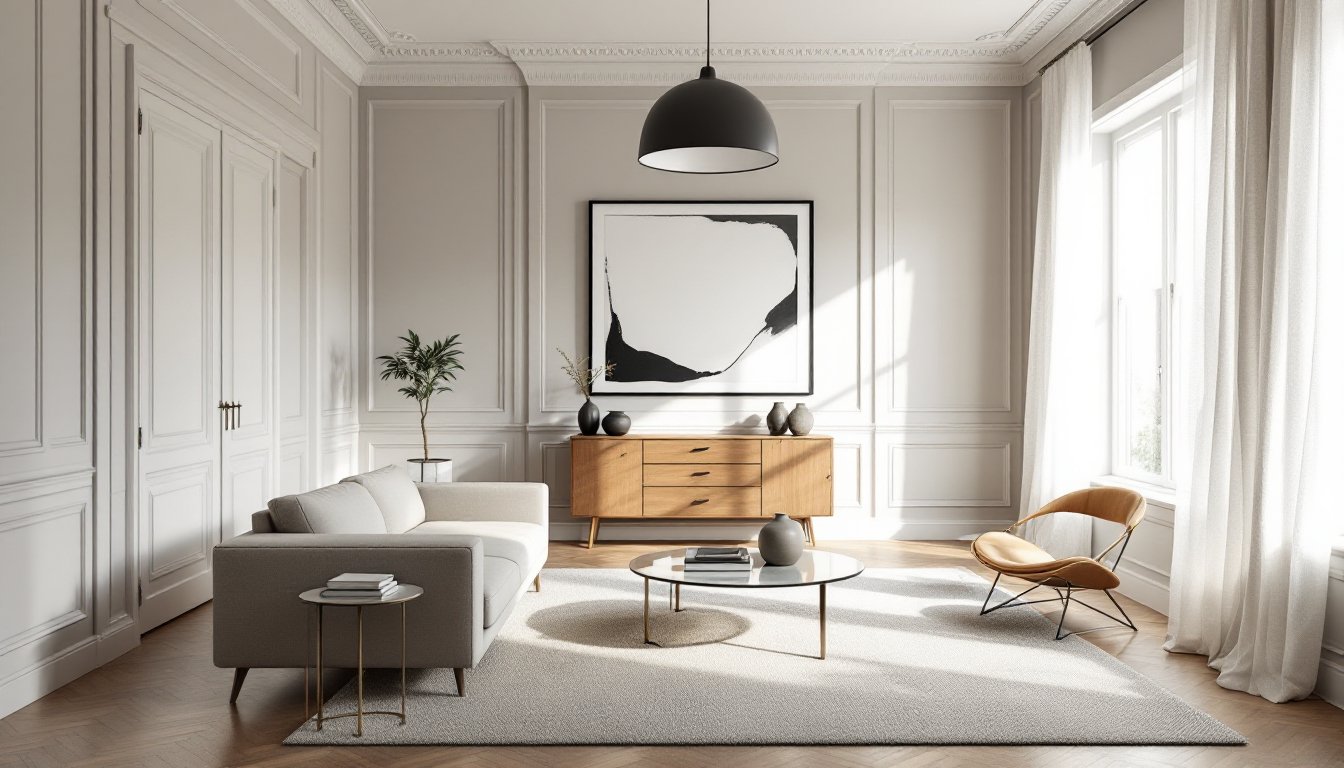
Classic modern interior design blends traditional architectural details with contemporary furnishings and a minimalist sensibility. It’s not mid-century modern, which references a specific postwar era, nor is it purely neoclassical. Instead, this style pulls from historical forms, crown molding, wainscoting, coffered ceilings, herringbone floors, and pairs them with furniture that has clean profiles, neutral upholstery, and minimal ornamentation.
The key is restraint. A room might feature original plaster medallions and tall baseboards but furnish the space with a low-profile sectional, glass-topped coffee table, and abstract art. The architecture provides gravitas: the furnishings keep it from feeling like a museum.
This approach works well in older homes where removing period details would be costly or damaging, and in new construction where builders sometimes add token trim that can be enhanced with thoughtful paint and furnishing choices. Homeowners don’t need to gut rooms or source rare antiques, most classic modern updates involve editing what’s already there and choosing furniture with intention.
Key Elements That Define the Classic Modern Aesthetic
Color Palettes and Materials
Classic modern spaces rely on a neutral foundation, whites, grays, beiges, taupes, and soft blacks, that let architectural features and a few statement pieces take focus. Paint choices matter. For trim and moldings, a semi-gloss or satin finish in pure white or off-white (not builder beige) creates crisp contrast against matte wall paint in warm gray or greige tones.
Materials should feel substantial. Hardwood flooring in oak, walnut, or maple (actual dimensions after milling: ¾” thick for solid strip flooring) works better than laminate. If budget limits solid wood, engineered hardwood with a 4mm wear layer offers durability and can be refinished once. For countertops, quartz or honed marble fits the aesthetic better than high-gloss granite or busy patterns.
Textiles add warmth without clutter: linen curtains, wool area rugs, leather upholstery, and cotton or linen throw pillows in solids or subtle textures. Avoid overly trendy prints or synthetic sheens that cheapen the look.
Metals should be consistent within a room, brushed nickel, oil-rubbed bronze, or matte black for hardware, light fixtures, and plumbing fixtures. Mixing more than two metal finishes in a single space starts to feel unintentional.
Furniture Selection and Placement
Furniture in a classic modern interior favors low profiles, straight lines, and exposed legs rather than skirted or heavily carved pieces. A sofa with track arms and tapered wood legs works better than a rolled-arm Chesterfield. Dining chairs might have ladder backs or molded plywood seats instead of tufted upholstery.
Scale matters. In a room with 10-foot ceilings, a sofa should be around 32–36 inches deep and 84–96 inches long to fill the space without overwhelming it. In a room with 8-foot ceilings, keep seating closer to 30 inches deep and avoid tall bookcases that crowd the vertical space.
Placement follows classic rules: arrange seating to encourage conversation, typically within 8–10 feet of each other. Anchor furniture groupings with an area rug that extends at least 6 inches beyond the front legs of sofas and chairs. Leave 30–36 inches of walkway clearance around major pieces.
Storage should be intentional. Built-ins, low credenzas, and wall-mounted shelving keep surfaces clear. Avoid open shelving crammed with tchotchkes, display a few carefully chosen objects (ceramics, hardcover books, a single vase) and leave negative space.
How to Incorporate Classic Modern Design in Different Rooms
Living room: Start with wall color. A soft warm gray (e.g., Sherwin-Williams Agreeable Gray or Benjamin Moore Revere Pewter) works as a neutral backdrop. If the room has existing crown molding or baseboards, paint them in a contrasting white. Add a low-profile sectional or sofa in linen or leather, a glass or wood coffee table with simple lines, and a large area rug in wool or jute. Swap out builder-grade light fixtures for a simple drum pendant or geometric chandelier. Hang one or two large-scale pieces of abstract or black-and-white photography rather than a gallery wall of small frames.
Kitchen: Classic modern kitchens pair Shaker-style cabinetry (flat-panel or recessed-panel doors, no ornate detailing) with contemporary hardware and countertops. If cabinets are dated, painting them in white, gray, or navy and replacing hardware with brushed nickel or matte black pulls is a manageable DIY project. Use a deglosser (liquid sandpaper) before priming with a bonding primer like Zinsser B-I-N or KILZ Adhesion, then apply a durable cabinet paint (Benjamin Moore Advance or Sherwin-Williams Emerald Urethane). Backsplashes in white subway tile or large-format porcelain slabs avoid busy patterns. Open shelving can work if kept minimal, three or four matching dishware sets, not a jumble of mismatched mugs.
Bedroom: Keep it serene. A platform bed or upholstered bed with a simple headboard centers the room. Nightstands should have clean lines, floating shelves or single-drawer tables in wood or metal. Skip heavy curtains: instead, use linen or cotton drapes on simple rods in black or brushed nickel. Layer bedding in neutral tones: white duvet, gray or taupe throw, and linen or cotton sheets. A single piece of art above the bed or a floor mirror with a thin frame adds interest without clutter.
Bathroom: Update builder-grade vanities by replacing standard chrome faucets with matte black or brushed nickel fixtures. If the vanity itself is dated, paint it (following the same prep as kitchen cabinets) and swap plastic knobs for metal pulls. Install a frameless or thin-framed mirror in place of ornate medicine cabinets. Replace Hollywood-style light bars with sconces or a linear vanity light in a simple metal finish. Use white or light gray porcelain tile for flooring or surrounds, nothing smaller than 3×6 inches for walls or 12×24 inches for floors to avoid a busy look.
Common Mistakes to Avoid When Creating a Classic Modern Space
Over-accessorizing. Classic modern design relies on restraint, so piling on throw pillows, vases, and decorative trays clutters the look. Stick to three pillows per sofa and a few curated objects on surfaces.
Ignoring scale. Furniture too small for a room floats awkwardly: furniture too large blocks walkways and makes spaces feel cramped. Measure twice, and use painter’s tape on the floor to mock up furniture footprints before buying.
Mixing too many styles. One or two antique or ornate pieces can ground a room, but combining Victorian, mid-century, and industrial elements without a unifying color palette or material thread creates visual chaos.
Skipping prep work on DIY updates. Painting cabinets or trim without proper cleaning, deglossing, and priming leads to peeling and chipping within months. TSP (trisodium phosphate) cleaner cuts grease and grime: a bonding primer ensures paint adhesion on slick surfaces.
Choosing trendy over timeless. Patterned tile, bold wallpaper, and colorful cabinetry date quickly. If a homeowner wants color, introduce it through easily swapped elements, pillows, art, throws, not permanent fixtures.
Neglecting lighting. Overhead lighting alone flattens a room. Layer in task lighting (under-cabinet, reading lamps) and ambient lighting (sconces, floor lamps) to add depth. Dimmer switches (simple to install, turn off power at the breaker, remove old switch, connect wires to new dimmer per manufacturer diagram) add flexibility.
Conclusion
Classic modern interior design rewards thoughtful editing and a focus on quality over quantity. By respecting architectural details, choosing furnishings with clean lines, and maintaining a restrained palette, homeowners create spaces that feel both polished and livable. The style doesn’t demand expensive overhauls, often, a fresh coat of paint, updated hardware, and smarter furniture placement deliver the biggest impact. For DIYers willing to measure carefully and prep surfaces properly, classic modern interiors offer a forgiving framework that adapts to different budgets and skill levels.